In every oilfield, whether in the deserts of the Middle East, the offshore rigs of West Africa, or the shale basins of Texas, there’s one thing every upstream oil and gas operation has in common — produced water. You won’t see it featured on the company brochure. It doesn’t have a shiny drilling rig or blazing flares attached to it. But quietly, day after day, produced water is one of the most complex, expensive, and under-acknowledged aspects of oil production.
We often say oil is the lifeblood of the oil and gas industry, but here’s a reality check: in most wells, we’re actually producing more water than oil.
Ask any field operator about produced water, and you’ll likely get a sigh. It’s the water that’s naturally present in underground formations and comes up along with oil and gas during production. But this isn’t clean water. It’s usually salty, oily, full of sediments, metals, and residual chemicals — nothing you’d want to spill or store casually.
In older fields, especially, you might be looking at a water cut of 80–90%. That means for every 10 barrels that come up, 8 or 9 are water. Managing this water becomes just as important as producing the oil itself.
To really understand the impact of produced water, you have to picture the people dealing with it on the ground.
In one onshore project I visited in 2023, the operations team had built an entire water treatment plant next to the main oil separator. “It’s like running two businesses side by side,” the site engineer told me. “One that makes the oil and another that manages the mess it brings along.”
Their day started with checking oil-water separation tanks, tweaking demulsifier dosing, and managing reinjection pump pressure — all just to ensure the water side of things didn’t trip up the whole production process.
If something goes wrong — say, a sudden surge in water cut or a scaling issue in the reinjection well — the oil output suffers. And the whole field feels the pinch.
The financial impact of produced water is real. Water management can account for 20–30% of a field’s OPEX, especially in brownfields.
One operations manager I spoke to in Abu Dhabi shared this: “We’ve reached a point where we’re spending more on managing water than on actual production lifting costs. It’s like paying rent on space you don’t use — you can’t avoid it, but it adds up fast.”
Transporting the water, treating it, injecting it back into the ground, or disposing of it safely — every step costs money, manpower, and time.
In some cases, trucking produced water to disposal wells 60–100 km away becomes the biggest logistical challenge. “That’s when you know your well has aged,” the logistics lead joked. “When you’re moving more barrels of water than crude.”
Read Also- Well-Being at Work: Why Workforce Health Matters in Remote Operations
Produced water is not just a technical headache — it’s a reputational and environmental minefield. Poor management can lead to surface spills, groundwater contamination, and in some cases, even seismic activity due to deep-well reinjection.
Communities living near oilfields are becoming increasingly conscious of water handling practices. I’ve been in town halls where farmers and locals have shown concern not about flares or noise, but about what happens to the water. In regions like West Texas, water is more valuable than oil. Every drop counts — whether it’s being used, reused, or discarded.
In response, regulators are tightening their grip. Permits for reinjection are harder to get. Discharge standards are becoming stricter. For operators in the oil and gas industry, the message is clear: Do better or slow down.
Not all stories about produced water are grim. In fact, some of the most inspiring innovations in upstream oil and gas today are around water reuse.
In Oman, for example, one operator is treating produced water and reusing it for steam generation in thermal EOR projects. In the U.S. Permian Basin, it’s common practice now to reuse treated water for hydraulic fracturing operations. This closed-loop system reduces freshwater demand and improves sustainability metrics.
But it’s not as easy as it sounds. Treating produced water requires specialized membranes, separation systems, chemical dosing, and monitoring. And those systems need to work reliably in harsh, remote environments — often with limited skilled manpower. Not to mention, the chemistry of produced water changes over time. What worked last year might not work today.
That’s why field operators say, “Water doesn’t follow rules.” It’s unpredictable — like the ocean in a bottle.
So why doesn’t produced water get more attention?
It’s not glamorous. It doesn’t increase production. It doesn’t improve your reserves. It doesn’t wow shareholders. But it can quietly erode profits, trip compliance audits, and put your license to operate at risk.
In the oil and gas industry, many challenges are visible — like declining reservoirs or safety incidents. But produced water is stealthy. It creeps in slowly. First a bit more water at the separator. Then scaling at the injection well. Then a spike in disposal costs. Then community pushback. And before you know it, it’s the problem no one budgeted for — but everyone has to solve.
Final Thoughts: Time to Rethink Water
Produced water is not just a “technical issue.” It’s a people issue, a cost issue, a regulatory issue, and a sustainability issue — all wrapped in one.
As oilfields mature and environmental scrutiny rises, the oil and gas industry’s ability to manage produced water efficiently, responsibly, and innovatively will define its resilience.
It’s time we started treating produced water not as a nuisance, but as a key performance indicator. How a company manages water may soon say more about its future than how much oil it can pump.
Because if oil is the prize, produced water is the price — and it’s one we can no longer afford to ignore.
Read Also- 5 Surprising Ways VMI Solves Supply Chain Challenges in the Upstream Oil and Gas Sector
By Get global | February 24, 2026
Choosing an oilfield service provider rarely feels like a risky decision at the start. On paper, most providers look capable. Certifications are in place. Equipment lists are impressive. Commercial terms appear competitive. The problems usually show up later. A few weeks into operations. After the first unplanned shutdown. When coordination […]

By Get global | February 19, 2026
In today’s constantly evolving energy landscape, selecting the right Upstream Oilfield Services Provider is not only essential but also a strategic decision that directly influences the performance, safety and well being of the workforce. The upstream oil and gas sector operates in one of the most hazardous and risk – […]
By Get global | February 16, 2026
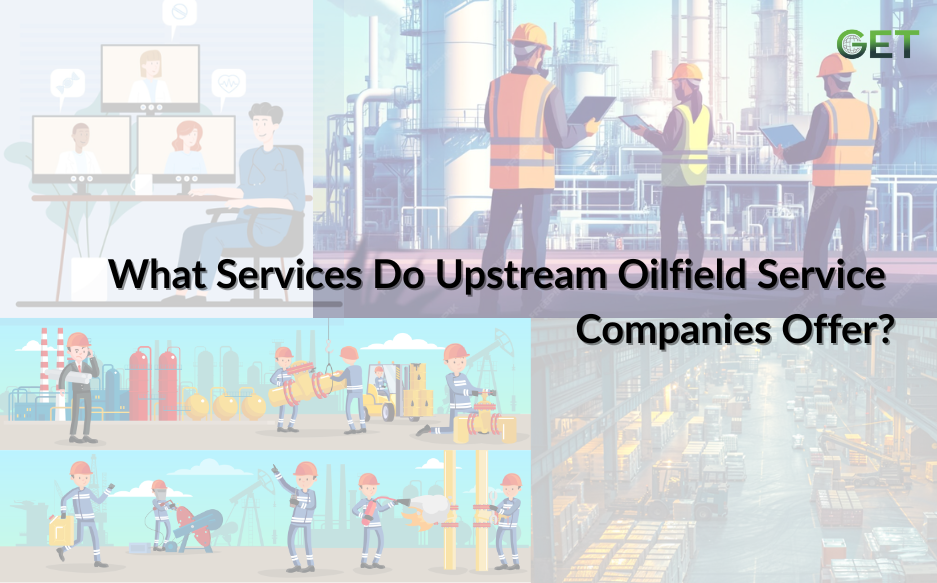
In today’s rapidly evolving energy landscape, the upstream segment is not only crucial in the oil and gas industry but also the basis of finding and exploring hydrocarbons. As projects move into deeper and much complex territories, upstream companies are involved in all the phases of the oil and gas […]

By Get global | January 30, 2026
Upstream oil and gas is where the real work starts. This is the part of the value chain where exploration wells are drilled, rigs are mobilized, and production systems are installed, often hundreds of kilometers away from stable ports, roads, or population centers. Logistics here supports drilling campaigns, well interventions, […]
By Get global | January 27, 2026
The oil and gas industry operates under unpredictable conditions which make it difficult for projects to succeed. When something goes wrong, it goes wrong fast. The situation develops into dangerous conditions which result in multiple fires, injuries, shutdowns and environmental damage that lasts for many years. The oil and gas […]