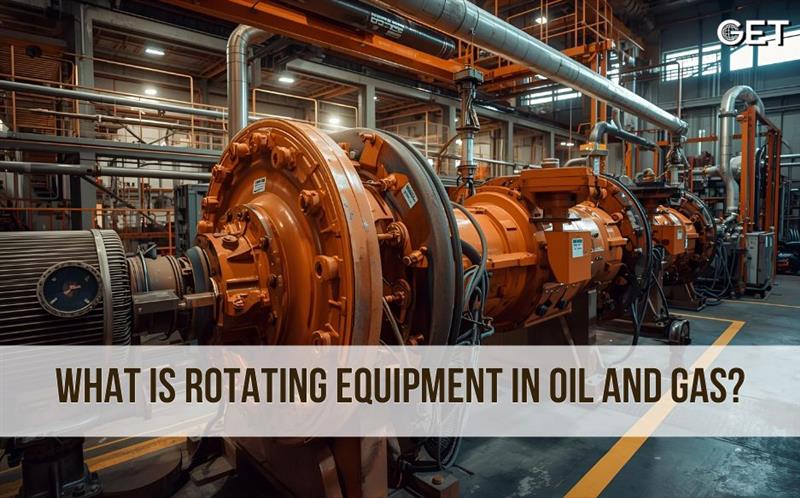
When you pass a refinery, or stand beside an oilfield you will hear one thing before you hear any other: the noise. The constant level of hum, the whirring of blades, the banging of engines. That is the noise of rotating machinery.
It may not be glamorous, but in the oil and gas business, rotating equipment is the muscle that does all the moving. No gas, no flow without it, no oil. The whole thing would come to a halt.
Simply put it is any device that utilizes a rotating component, a shaft, an impeller ,or a rotor, to drive fluids or produce energy. Pumps, compressors, turbines, engines, even fans and blowers are included in this category.
Such fixed equipment as tanks or pressure vessels merely sit there. Rotating equipment, on the other hand, is alive. It rotates, vibrates, and forces power through the system. That is why oilfield workers usually refer to it as the heartbeat of an operation.
Every part of upstream oil and gas, the exploration, drilling, and production phase, relies on these machines.
If one critical pump or compressor goes down, production can stall. And downtime in the oilfield isn’t just inconvenient, it’s expensive.
Let’s break it down a little:
Together, they form the machinery backbone of every oilfield operation.
Here’s the catch: anything that spins is going to wear out. Bearings break down. Seals leak. Vibration slowly misaligns parts. And in the harsh environments of oil and gas, offshore salt spray, desert dust, freezing cold, rotating machines take a beating.
Maintenance teams fight three battles:
That’s why predictive maintenance is becoming the standard. Engineers now use sensors to monitor vibration, heat, and pressure in real time, so problems can be spotted before they snowball.
This is where things get interesting. Modern oilfield operations aren’t just about grease and wrenches anymore, they’re about data.
Sensors embedded in rotating equipment send streams of information back to control rooms. AI algorithms can now flag unusual vibration patterns in a pump, warning teams weeks in advance that something’s about to fail. Instead of waiting for a breakdown, operators can swap out a part on their schedule, not the machine’s.
Organizations like API and DNV are also constantly updating best practices to make sure this new mix of machinery and digital monitoring works safely together.
Read Also- What is a Wellhead in Upstream Oil and Gas?
Imagine an offshore platform in the middle of the sea. Supplies are limited. The weather is unpredictable. The closest spare part might be hundreds of miles away.
On that platform, compressors, pumps, and turbines cannot fail. They run day and night, no breaks, no excuses. If a compressor trips, gas production halts. Ships wait. Deadlines slip. Sometimes, flaring (burning gas) becomes the only stopgap, which nobody wants.
That’s why offshore operators often install backup systems and rely heavily on remote monitoring. For them, rotating equipment really is the difference between profit and loss.
Rotating equipment is easy to imagine as old-school engineering, although it is also a piece of the future of the industry. The compressors and pumps that are used today to transport hydrocarbons could be modified to pump hydrogen or inject carbon dioxide to store it.
That is, rotating equipment will not be discarded; it will be used elsewhere as the energy transition occurs.
The rotating equipment may not receive the fame, but it is the heartbeat of the oilfield operations. The motions that cause energy to flow out of the deep underground to the above world are pumps, compressors, turbines, motors, and fans.
And while technology changes how they’re monitored and maintained, one fact stays the same: without rotating equipment, the oilfield stops.
In GET Global Group, we assist businesses to address the issues with the management of this important equipment, downtime minimization, efficiency enhancement, and operations safety. We can help you out in case your oil and gas projects rely on the services of reliable rotating machinery.
Read Also- How Oil & Gas Companies Can Lead the Energy Transition
By Get global | February 24, 2026
Choosing an oilfield service provider rarely feels like a risky decision at the start. On paper, most providers look capable. Certifications are in place. Equipment lists are impressive. Commercial terms appear competitive. The problems usually show up later. A few weeks into operations. After the first unplanned shutdown. When coordination […]
By Get global | February 19, 2026
In today’s constantly evolving energy landscape, selecting the right Upstream Oilfield Services Provider is not only essential but also a strategic decision that directly influences the performance, safety and well being of the workforce. The upstream oil and gas sector operates in one of the most hazardous and risk – […]
By Get global | February 16, 2026
In today’s rapidly evolving energy landscape, the upstream segment is not only crucial in the oil and gas industry but also the basis of finding and exploring hydrocarbons. As projects move into deeper and much complex territories, upstream companies are involved in all the phases of the oil and gas […]
By Get global | January 30, 2026
Upstream oil and gas is where the real work starts. This is the part of the value chain where exploration wells are drilled, rigs are mobilized, and production systems are installed, often hundreds of kilometers away from stable ports, roads, or population centers. Logistics here supports drilling campaigns, well interventions, […]

By Get global | January 27, 2026
The oil and gas industry operates under unpredictable conditions which make it difficult for projects to succeed. When something goes wrong, it goes wrong fast. The situation develops into dangerous conditions which result in multiple fires, injuries, shutdowns and environmental damage that lasts for many years. The oil and gas […]