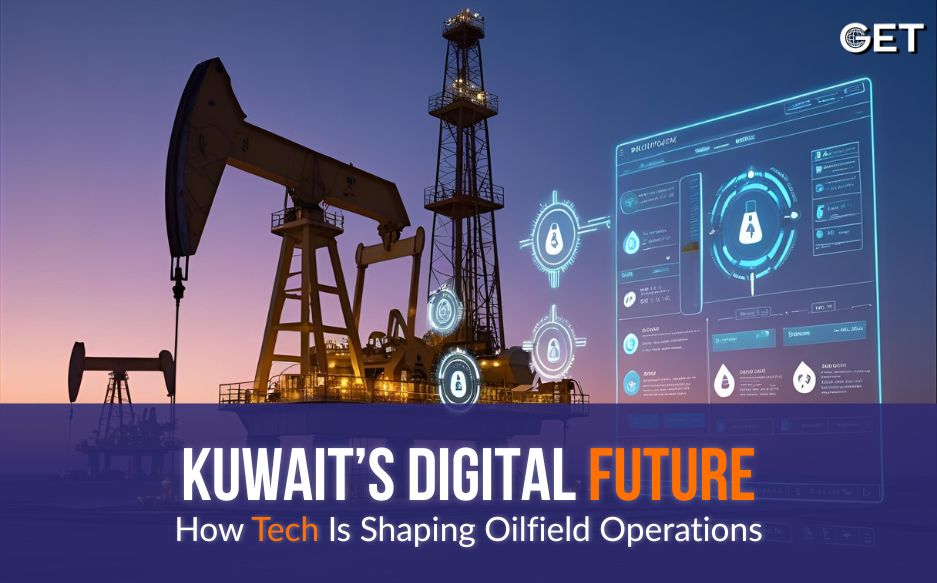
Years ago, if you ever visited an oilfield in Kuwait, you would see crews checking gauges and valves in extreme heat with clipboards in hand.
However, years later if you decide to visit an oilfield today, you would see a completely different scenario: there would be technically equipped crews with screens in their hands, replacement of traditional equipment with new-age technology like drones replacing scaffoldings, and live decisions being made not only based on experience but also real-time data.
It goes way beyond just a facelift; it is a deeper shift in how the upstream oil and gas industry works on the ground and into the world. With an average estimated production of around 2.4 to 2.5 million barrels per day in 2025, even a tiny increase in efficiency would mean millions of extra dollars. To keep the oilfield operations efficient and predictable, now Kuwait is moving heavily towards the adoption of digital tools like AI, IoT sensors, and cloud platforms.
Although the story now focuses on the technological adoption, the conversation revolving around the economic diversification for the country’s Vision 2035 (New Kuwait) is often talked about. The plan now focuses on modern infrastructure, industries backed and driven by data, and upskilling its workforce.
In oil and gas, that translates into fewer manual delays and more real-time decisions, because in this business, hours matter. (New Kuwait Portal)
At the heart of Kuwait’s upstream oil and gas industry is the Kuwait Integrated Digital Field program.
If the oilfield is a living organism, KwIDF is its nervous system. It pulls together:
Instead of field teams waiting days for data to be processed, engineers can now tweak well settings in hours. A lift strategy that once took a week to finalize might be approved before the next shift change.
Industrial IoT: Thousands of small devices track temperature, pressure, flow, and even vibration patterns. This isn’t “data for the sake of data”; it’s an early warning. Globally, IoT-enabled monitoring can reduce unplanned downtime by up to 30%.
AI and Predictive Maintenance: Pumps and compressors fail less when you can see the trouble coming. In industry surveys, about 40% of oil and gas leaders rank predictive maintenance as AI’s top payoff. Kuwait’s AI models are starting to make those early calls, flagging problems before they break budgets.
Cloud Collaboration: Instead of shipping hard drives or waiting for files to sync, teams can run reservoir simulations and share dashboards instantly. BCG puts the Middle East’s potential cloud-driven value in the billions.
Drones: A flare stack inspection used to mean scaffolding, safety harnesses, and days of prep. Now it’s often a drone flight, finished before lunch. Some reports say inspections are up to 90% faster this way.
The timing isn’t random. The IEA expects oil demand to hover near 103.9 million barrels per day in 2025. That’s steady, but competitive margins matter. Add to that a regional AI market that could bring $150 billion in GDP impact by 2030, and the incentive is obvious: be faster, leaner, and safer.
Some of the gains are already visible:
They’re not miracles, just the compounding effect of small, faster decisions adding up over time.
Not everything clicks into place on day one. Kuwait’s digital journey still has to overcome:
These aren’t show-stoppers, but they do require deliberate investment in hardware, training, and strong security protocols.
In a digital oilfield, technology is just one of the elements. The implementation requires the right people, the right equipment, and the right support systems so that it can work in the real world. GET Global Group comes in at that point.
We have boots-on-the-ground experience to keep the oilfield machines rolling in Kuwait, be it modernization in terms of IoT sensors, predictive maintenance, or enhancement of uptime in general.
Here’s how we make it happen:
Our goal is simple: make sure people, processes, and technology come together to deliver measurable results in the field.
Read Also- Upstream Oil and Gas: Exploring Key Operations and Insights
By Get global | February 24, 2026
Choosing an oilfield service provider rarely feels like a risky decision at the start. On paper, most providers look capable. Certifications are in place. Equipment lists are impressive. Commercial terms appear competitive. The problems usually show up later. A few weeks into operations. After the first unplanned shutdown. When coordination […]
By Get global | February 19, 2026
In today’s constantly evolving energy landscape, selecting the right Upstream Oilfield Services Provider is not only essential but also a strategic decision that directly influences the performance, safety and well being of the workforce. The upstream oil and gas sector operates in one of the most hazardous and risk – […]
By Get global | February 16, 2026
In today’s rapidly evolving energy landscape, the upstream segment is not only crucial in the oil and gas industry but also the basis of finding and exploring hydrocarbons. As projects move into deeper and much complex territories, upstream companies are involved in all the phases of the oil and gas […]
By Get global | January 30, 2026
Upstream oil and gas is where the real work starts. This is the part of the value chain where exploration wells are drilled, rigs are mobilized, and production systems are installed, often hundreds of kilometers away from stable ports, roads, or population centers. Logistics here supports drilling campaigns, well interventions, […]

By Get global | January 27, 2026
The oil and gas industry operates under unpredictable conditions which make it difficult for projects to succeed. When something goes wrong, it goes wrong fast. The situation develops into dangerous conditions which result in multiple fires, injuries, shutdowns and environmental damage that lasts for many years. The oil and gas […]